
Conclusion first: ion exchange in 2026 is moving from bulk demineralization toward selective removal and final polishing. RO can remove most dissolved salts, and EDI can continuously reduce ionic contaminants, but difficult residuals such as boron, silica, trace metals and final ionic leakage often require a more targeted polishing step. That is where cation, anion and mixed-bed resins are being joined by boron-selective resin and other specialty materials.
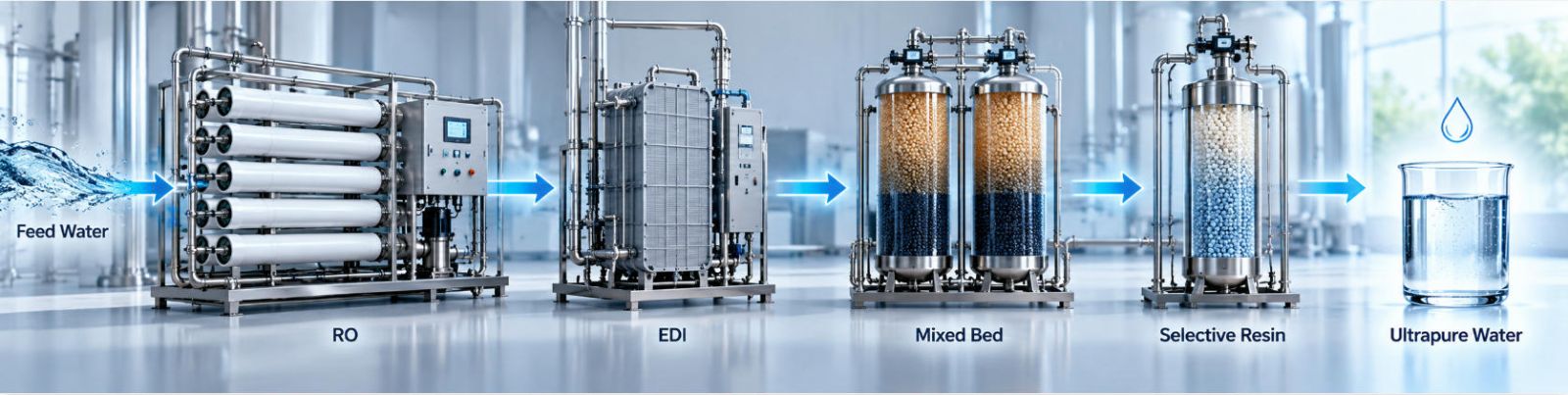
The better question is no longer “resin or membrane?” but which technology should carry which load? For many industrial systems, cation exchange resin, anion exchange resin and mixed-bed resin remain the core ion-removal tools, while RO, EDI and selective resins solve different parts of the treatment train.
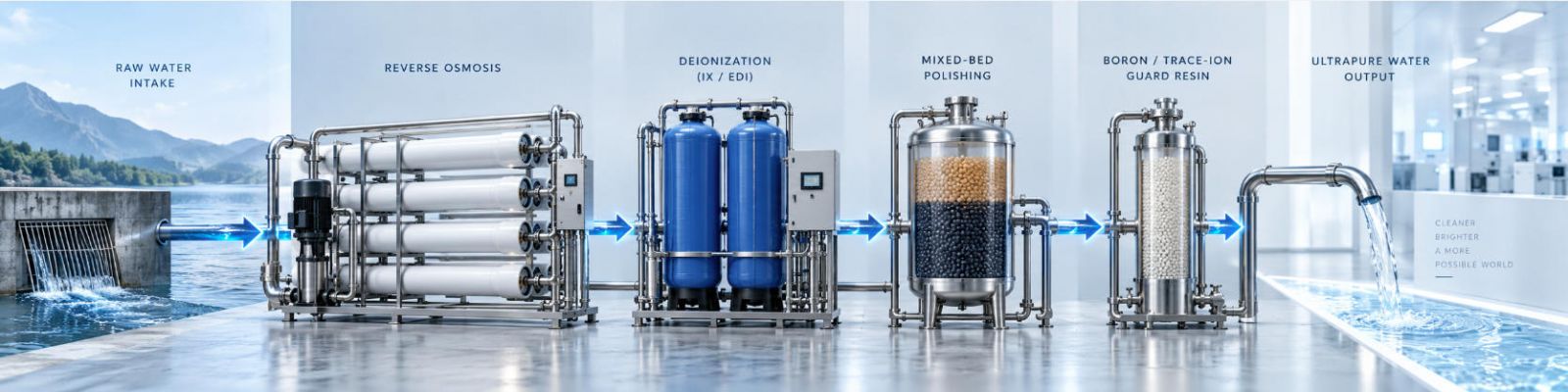
Traditional demineralization asks how much ionic load must be removed. High-value polishing asks which contaminant will break specification first. That difference changes the purchasing criteria.
Current semiconductor-grade portfolios from DuPont and Ecolab/Ovivo illustrate the shift. High-purity mixed beds are positioned around low ionic leakage, fast rinse-down, low TOC and metal release, and control of difficult residuals such as boron and silica. SEMI C93 likewise focuses on the quality of high-purity ion exchange resin used in UPW polishing, because at this stage the resin can become both the purifier and a possible contamination source.
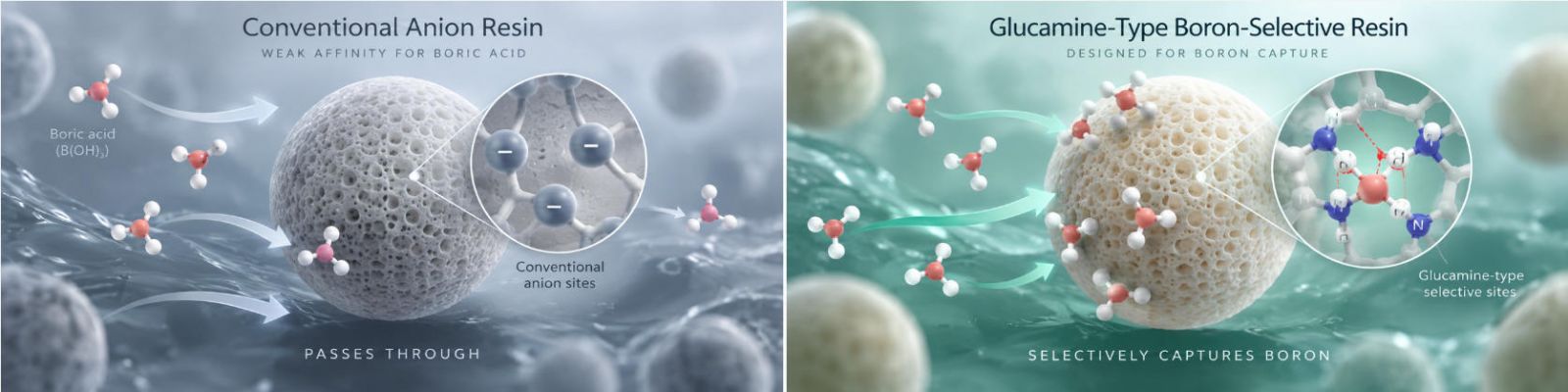
Boron is difficult because conventional ion exchange works best when the target is strongly charged. Around neutral pH, much of dissolved boron exists as weakly ionized boric acid, so conventional strong-base anion resin has relatively low selectivity for it.
Boron-selective resin changes the mechanism. Functional groups such as N-methyl-D-glucamine bind boron more specifically, making selective removal possible after the bulk ionic load has already been reduced.
A published Nomura Micro Science example used a combination of boron-selective chelate resin + strong acid cation resin + strong base anion resin. The mixed system was designed not only to capture boron but also to remove leachables and organic acids that could interfere with boron chelation. In that reported application, boron was maintained below 1 ppt for more than one year.
| Material | Best Role | Main Strength | Main Limitation |
|---|---|---|---|
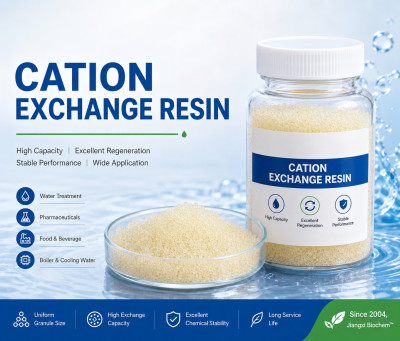
| Cation Exchange Resin | Hardness removal, demineralization, cation polishing | Mature, high-capacity removal of Ca²⁺, Mg²⁺, Na⁺ and other cations | Cannot remove anions |
| Anion Exchange Resin | Demineralization, residual anion and silica control | Core partner to cation resin | Conventional SBA resin is relatively weak for boric acid |
| Mixed Bed Resin | Final polishing | Very low ionic leakage from closely coupled H⁺ and OH⁻ exchange | Wasteful if upstream ionic load is still high |
| Boron-Selective Resin | Selective boron capture | Specific chemical affinity for boron | Higher specialty-material cost and narrower purpose |
| Strong Acid Cation Exchange Fiber | Fast cation exchange and specialty modules | Short diffusion path and rapid mass transfer | Less standardized than bead resin for large fixed beds |
Mixed-bed resin is not simply cation and anion resin poured together. Because the two resins are intimately mixed, water experiences many local cation-anion exchange steps inside one vessel. This can reduce ionic leakage below what separate beds normally achieve.
For electronics and semiconductor service, high-purity mixed beds also emphasize H⁺/OH⁻ conversion, low fines, controlled particle size, low TOC and low metal leakage. The most relevant question is often not “What is the cation-to-anion ratio?” but “What contaminant defines breakthrough, how fast does the bed rinse down, and how clean is the resin itself?”
| Technology | Best Use | Strength | Watch Item |
|---|---|---|---|
| RO | Bulk desalting | Removes most dissolved salts before polishing | Boron rejection can be difficult depending on pH and membrane conditions |
| EDI | Continuous deionization after RO | Electrical regeneration reduces conventional acid/caustic regeneration | Requires good pretreatment and stable feed |
| Cation + Anion Resin | Demineralization | Mature chemistry, high capacity, flexible design | Regeneration or replacement required |
| Mixed Bed Resin | Final polishing | Extremely low ionic leakage | Should not carry unnecessary bulk load |
| Selective Resin | Boron or specific trace contaminants | Targets the impurity that controls specification | Higher cost and narrower use |
Ion-exchange fiber is interesting because geometry changes mass transfer. Functional groups can sit closer to the external surface, reducing diffusion distance and enabling faster exchange in some applications.
The conclusion is not that fiber is “better resin.” It is a different exchange geometry. For large demineralization systems, bead resin remains the default; for specialty high-kinetics applications, fiber may justify a separate feasibility study.
| Main Problem | Start With | Upgrade When... | Key Metric |
|---|---|---|---|
| Hardness / cation load | Cation Exchange Resin | Trace cation leakage becomes critical | Operating capacity, selectivity, regeneration efficiency |
| General demineralization | Cation + Anion Resin | Silica, boron or TOC becomes limiting | Capacity, leakage, fouling resistance |
| Very low conductivity after RO/EDI | Mixed Bed Resin | Boron, silica, metals or TOC break specification first | Resistivity, TOC, metal leakage, rinse-down |
| Boron is limiting | Boron-Selective Resin | Conventional SBA or RO cannot meet target | Boron breakthrough, competing ions, rinse-down |
| Very short contact time | Ion Exchange Fiber study | Mass transfer controls system size | Kinetics, pressure drop, module stability |
A meaningful RFQ should include feed-water analysis, target outlet quality, flow, temperature, pH, competing ions, regeneration method and the contaminant expected to define breakthrough. For polishing systems, add rinse-down time, TOC, trace metal leakage, ionic form, particle cleanliness and whether the product is a working bed or ready-to-use final polisher.
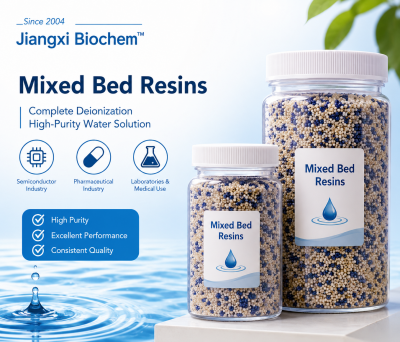
Jiangxi Biochem Co., Ltd. supplies and sources cation exchange resin, anion exchange resin and mixed-bed resin for international customers. The practical value is not simply offering a resin grade, but matching the material to the actual water-quality problem—especially when the project involves small-volume, urgent or application-specific requirements.
Jiangxi Biochem supports international sourcing of cation exchange resin, anion exchange resin and mixed-bed resin for demineralization, polishing and application-specific water treatment.
Website: www.biochemjx.cn
Ion Exchange Resin: Product Portfolio
Email: iceleng@biochemjx.com
Latest Blogs & News
Products
Contact us
Add: 1-6F, No.118 Xinzhou Road, Xihu District, Nanchang, Jiangxi, China Post: 330025
Tel:+86-791-86629460
E-mail: iceleng@biochemjx.com