----News
From Precision Etching to Controlled Reactivity: Why Boron Trichloride Is Splitting into Two Supply Tracks in 2026
Date: 2026-09-07
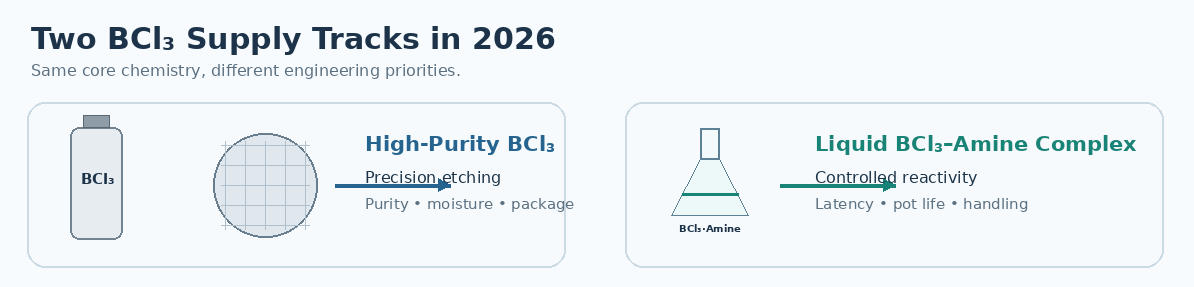
Conclusion first: Boron trichloride is increasingly being purchased under two very different technical logics in 2026. One track pushes toward ultra-high-purity BCl3 for precision semiconductor processing, where impurity control, moisture management and delivery reliability are inseparable from process performance. The other uses BCl3–amine complexes to deliberately moderate free Lewis-acid reactivity, creating a wider processing window in epoxy, composite and other thermosetting formulations. These are not substitutes for one another; they solve different engineering problems.
This distinction matters for procurement. A buyer comparing only “BCl3 purity” may miss the real decision: does the process require the fastest available free Lewis acid, a solvent-delivered BCl3 system, or a coordinated BCl3–amine complex that sacrifices immediate reactivity in exchange for latency and control? The answer changes the required specification, packaging, manufacturer profile and even the type of supplier that can support the project.
Track AHigh-Purity BCl3
Precision etching, semiconductor process chemistry, high-spec synthesis.
Track BLiquid BCl3–Amine Complex
Controlled Lewis acidity, latent cure/acceleration, formulation working window.
Related FormsBCl3 Solutions + BF3 / BBr3
Alternative delivery or boron-halide chemistry for specific process needs.
Why the High-Purity BCl3 Track Is Becoming More Demanding in 2026
The semiconductor side of the market is moving toward tighter process windows, not simply higher consumption. An August 2026 Applied Surface Science study optimized etching of 10 nm Al2O3 films at the bottom of high-aspect-ratio trenches and identified BCl3 as important to both etch activity and selectivity in a Cl2/BCl3/Ar plasma. That is useful evidence because it links BCl3 directly to the precision challenge facing advanced device structures rather than treating it as a generic etch gas.
Commercial market research published in 2026 estimates semiconductor-grade BCl3 at about US$222.3 million in 2026, up from about US$202.2 million in 2025, while segmenting the market by purity levels that extend above 99.999%. Market-research forecasts should be treated as directional rather than audited industry statistics, but the purchasing message is consistent with what materials suppliers are doing: advanced semiconductor manufacturing is placing more value on purity, traceability and continuous supply.
Evidence from process research
10 nm Al2O3
2026 trench-bottom etching research showed BCl3 was important for both activity and selectivity in the optimized plasma process.
Evidence from the supply ecosystemIn July–September 2026, Linde, Air Liquide and Solvay announced major new investments in ultra-high-purity gases or electronic-grade chemicals supporting advanced semiconductor capacity in the U.S., Korea and Taiwan. These investments are broader than BCl3, but they confirm the direction of the electronic-chemicals market: higher purity and supply reliability are becoming strategic infrastructure.
For a buyer, this changes the qualification question. “Is the BCl3 99.99%?” is no longer enough for demanding applications. A meaningful specification may also need to address moisture, relevant metallic or non-metallic contaminants, analytical detection limits, cylinder/passivation history, valve and package compatibility, lot traceability and shelf-life behavior. Boron Trichloride (BCl3) therefore becomes a material-and-delivery-system qualification, not just a gas assay.
Procurement implication: the value of a higher-purity BCl3 grade is only realized when the analytical method, package condition and logistics chain are capable of preserving that grade until it reaches the point of use.
The Second Track: Why BCl3–Amine Complexes Are About Controlled Reactivity
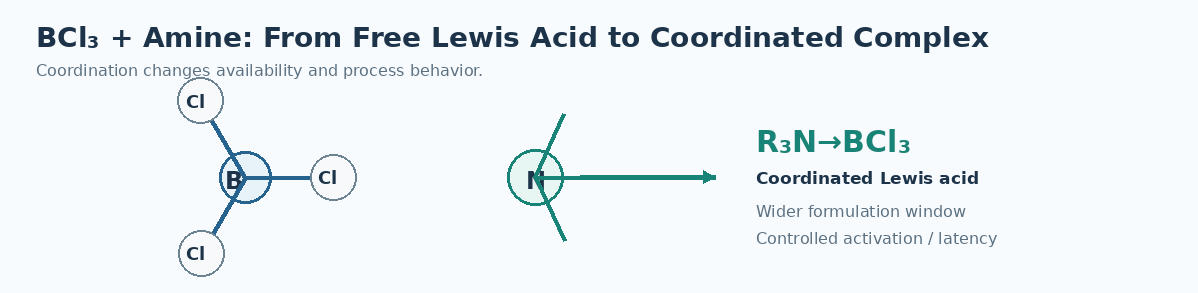
A BCl3–amine complex solves a different problem: how to keep strong Lewis-acid chemistry available without exposing the formulation to the full behavior of free BCl3 from the beginning. In simple Lewis acid–base terms, the nitrogen lone pair coordinates to electron-deficient boron:
BCl3 + R3N ⇌ R3N→BCl3
Free BCl3: highly available Lewis acid
Coordinated BCl3: reactivity is modified by amine coordination and formulation conditions
This is why “BCl3–amine complex” should not be marketed as liquid BCl3 in a convenient bottle. It is a different chemical delivery concept. The amine identity, stoichiometry, physical form and release/activation behavior influence latency, cure response and compatibility with the resin system.
A February 2026 U.S. patent application for thermosetting resin compositions and fiber-reinforced composite materials specifically selected boron amine complexes to obtain long pot life and stated a preference for a boron trichloride amine complex over a boron trifluoride amine complex for that purpose. A separate 2026 Japanese patent publication also lists boron trichloride–dimethyloctylamine complex among suitable systems. These patents do not prove a broad market-size expansion, but they are strong evidence that BCl3–amine complex chemistry remains active in current advanced formulation development.
Free BCl3 Track
When maximum available Lewis acidity or gas-phase process control matters
- Semiconductor plasma etching and related process chemistry
- High-specification boron chemistry
- Processes that can manage corrosive, moisture-sensitive BCl3 directly
- Qualification centered on purity, impurities, cylinder/package and continuity
BCl3–Amine Complex Track
When latency, formulation stability and a wider working window matter
- Epoxy curing and acceleration systems
- Prepreg, composite, potting and adhesive formulations
- Applications where immediate free-acid activity is undesirable
- Qualification centered on complex identity, active content, physical form and cure response
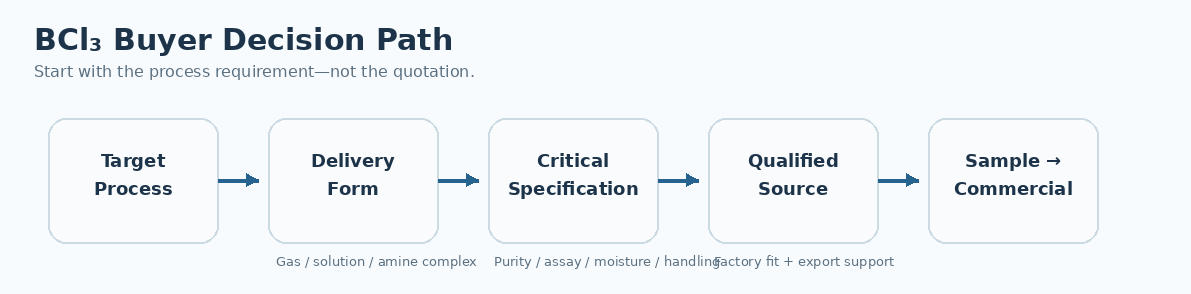
Gas, Solution or Amine Complex? Choose the Delivery Form Before Comparing Price
BCl3 is also commercially delivered in solvent systems. Current supplier and catalog references include BCl3 in dichloromethane, n-heptane, n-hexane and xylene. These forms can simplify metering or match a customer's reaction medium, but the solvent is part of the specification—not an inert footnote.
| Delivery Form |
What It Changes |
Typical Buyer Question |
Qualification Priority |
| High-purity BCl3 gas |
Maximum direct access to BCl3; gas-handling infrastructure required. |
Does the process need electronic-grade or high-spec gas? |
Purity profile, moisture, package/cylinder, valve, traceability and delivery continuity. |
| BCl3 in dichloromethane |
Converts a gas reagent into a metered solution compatible with some organic synthesis workflows. |
Is DCM acceptable in the reaction and downstream purification? |
Concentration, water, solvent grade, package and concentration stability. |
| BCl3 in n-heptane / n-hexane / xylene |
Offers hydrocarbon/aromatic solvent options for processes that do not want DCM. |
Which solvent best fits the existing process and safety controls? |
Solvent identity, concentration, moisture, impurities and materials compatibility. |
| Liquid BCl3–amine complex |
Changes the chemical availability of BCl3 through amine coordination; can provide latency or controlled activation. |
Which amine complex and cure/activation profile is required? |
Complex identity, assay, water, physical form, viscosity/handling and formulation performance. |
The key point is that these forms are not a linear quality ladder. Gas is not automatically “better” than solution, and a liquid amine complex is not simply “safer BCl3.” Each form changes how BCl3 enters the process. Selection should begin with the chemistry and plant workflow, then move to quotation.
What Should Be on the RFQ for a Liquid BCl3–Amine Complex?
For a niche product such as a liquid Boron Trichloride–Amine Complex, a generic inquiry such as “Please quote BCl3 amine complex” is usually insufficient. Commercial products can differ in amine component and physical form, and those differences can alter latency and cure response.
1. Chemical identitySpecify the amine component or accepted commercial-equivalent chemistry, not only “BCl3 complex.”
2. Active / assay basisDefine whether the requirement is assay, BCl3-equivalent content, or another agreed analytical basis.
3. Moisture and impurity limitsEspecially important for storage stability and reproducible cure behavior.
4. Physical-form windowLiquid range, viscosity or pumpability can matter more than a generic appearance description.
5. Target formulationEpoxy type, hardener/accelerator system, desired pot life and cure temperature determine whether the complex is appropriate.
6. Package and order profileSmall trial lot, scale-up lot and commercial package may require different sourcing solutions.
This is also where an experienced trading and sourcing company can be useful. A single factory may be strong in high-purity BCl3 gas but not in a specific amine adduct, while another producer may focus on specialty complexes or solvent grades. Jiangxi Biochem Co., Ltd. operates as an export-oriented chemical sourcing partner with access to multiple factory resources, which is particularly relevant for small lots, urgent requirements and customized specifications that do not fit a standard high-volume production model.
Where BF3 and BBr3 Still Fit Into the Boron-Halide Decision
Boron Trifluoride (BF3) and Boron Tribromide (BBr3) remain relevant, but they should be treated as separate chemistries rather than fallback substitutes for BCl3. BF3 has a long history in Lewis-acid catalysis and is also commercially supplied through multiple complexes; BBr3 is particularly valued in high-value organic synthesis and demethylation chemistry. Their different volatility, coordination behavior and reaction selectivity mean substitution must be demonstrated in the real process.
For buyers building a broader boron-halide supply program, Jiangxi Biochem's Boron Series provides a useful starting point for comparing BCl3, BF3 and BBr3 requirements while keeping each product's specification and application logic separate.
2026 Buyer Strategy: Qualify the Reaction Window, Not Just the Chemical Name
The most useful 2026 sourcing question is no longer “Who sells BCl3?” but “Which BCl3 delivery form gives this process the required reaction window with acceptable qualification and supply risk?” Semiconductor users are moving toward tighter contamination control and more reliable electronic-chemical infrastructure. Composite and thermoset developers continue to explore boron–amine complexes because controlled latency can be more valuable than maximum immediate acidity.
That creates a sourcing opportunity for specialists who can bridge different manufacturing resources. High-purity gas, solvent solutions and amine complexes can sit in different supply chains even though they share BCl3 chemistry. For urgent, small or customized orders, the ability to identify the right producer, reconcile analytical methods, arrange suitable packaging and communicate clearly with the overseas buyer can be as important as the factory gate price.
Important boundary: the 2026 evidence supports two distinct application and qualification logics for BCl3; it does not prove that liquid BCl3–amine complexes are replacing semiconductor-grade BCl3, nor that every BCl3 user should change delivery form. The correct choice remains application-specific.
FAQ: Technical Questions Buyers Ask About BCl3 and BCl3–Amine Complexes
Why does high-purity Boron Trichloride (BCl3) require more than a purity number for semiconductor qualification?
Because advanced etch processes are sensitive not only to headline assay but also to moisture, trace contaminants, packaging integrity, analytical method, cylinder history and lot-to-lot consistency. A 2026 Applied Surface Science study on 10 nm Al2O3 trench-bottom etching showed that BCl3 directly influenced etch activity and selectivity, reinforcing why process users qualify the complete material-and-delivery system rather than a single percentage.
How is a liquid Boron Trichloride–Amine Complex different from free Boron Trichloride (BCl3)?
Free BCl3 is a highly reactive Lewis acid. When an amine donates its lone pair to boron, an R3N→BCl3 coordination complex forms and the availability of free Lewis acid is altered. In thermosetting systems this can create latency and a wider working window. The exact behavior depends on the amine, complex composition and formulation, so a BCl3–amine complex should not be treated as a simple liquid substitute for BCl3 gas.
When should buyers consider Boron Trichloride (BCl3) solutions in dichloromethane, heptane, hexane or xylene?
A BCl3 solution can simplify metering and integration when the solvent is compatible with the customer's process. The solvent, concentration, water content, package and downstream reaction must all be qualified. A solution changes the delivery form; it does not remove the inherent moisture sensitivity and corrosive/reactive nature of BCl3.
What should buyers specify when sourcing a liquid Boron Trichloride–Amine Complex for epoxy or composite formulations?
The inquiry should identify the amine or commercial-equivalent chemistry, assay or active content, physical form, viscosity or handling range where relevant, moisture limit, packaging, target resin system and required latency or cure-response window. Asking only for 'BCl3 amine complex' is usually too broad for formulation qualification.
Can Boron Trifluoride (BF3) or Boron Tribromide (BBr3) replace Boron Trichloride (BCl3) in the same process?
Not as a general rule. BF3, BCl3 and BBr3 are all Lewis acids, but their volatility, halogen identity, coordination behavior, reaction selectivity, delivery forms and application history differ. Substitution must be demonstrated in the actual reaction or formulation rather than inferred from Lewis-acid classification alone.
Why can a sourcing partner add value for Boron Trichloride (BCl3) and BCl3–Amine Complex orders?
These products can require different upstream manufacturers, packaging formats, order sizes, export documents and technical clarification. A sourcing partner with multiple factory resources can be useful when a customer needs a small or urgent lot, a solvent-specific BCl3 solution, a non-standard BCl3–amine complex, or coordinated documentation across more than one boron-halide product.
Sources and Verification Notes
Applied Surface Science — August 15, 2026. Precision etching study of 10 nm Al2O3 at the bottom of high-aspect-ratio trenches; BCl3 was identified as important to etch activity and selectivity.
View source
U.S. Patent Application 20260035557 — February 5, 2026. Thermosetting resin / fiber-reinforced composite disclosure using boron amine complexes for long pot life, with BCl3–amine complex preferred in the described system.
View source
Linde — July 31, 2026. US$1 billion investment supporting ultra-high-purity gases for advanced semiconductor facilities in Arizona, plus additional Taiwan investments; used here as a semiconductor materials-supply trend indicator, not as BCl3-specific demand data.
View source
Reuters / Solvay — September 3, 2026. Solvay announced a more-than-doubling of ultra-pure hydrogen peroxide capacity in Taiwan as chipmakers expand advanced-node capacity. This is a cross-check on the broader electronic-chemicals purity trend, not BCl3 market-size evidence.
View source
Research and Markets — 2026 edition. Semiconductor-grade BCl3 market estimate of approximately US$222.31 million for 2026. Included as directional commercial research and clearly separated from primary technical evidence.
View source
Current commercial delivery-form references. Sigma-Aldrich lists 1.0 M BCl3 in methylene chloride; Chinese industry suppliers publicly list BCl3 solutions in dichloromethane, n-heptane, n-hexane and xylene. These references support delivery-form availability, not universal process equivalence.
Need a BCl3 Grade That Does Not Fit a Standard Factory Catalog?
Jiangxi Biochem supports international customers who need high-purity boron halides, small or urgent orders, solvent-specific BCl3 solutions, or customized specialty-chemical sourcing. For a BCl3–amine complex inquiry, send the target amine chemistry or reference grade, application, required assay/physical form, sample quantity and expected commercial volume so that the sourcing route can be matched more accurately.
Return