

As winter shipping and maintenance schedules approach, ion-exchange resin buyers face three different situations: unused resin in an unopened package, an opened pack in storage, and resin left in an idle pressure vessel. A pre-blended mixed bed also requires different checks from separate cation and anion beds. This guide turns those differences into a receiving and restart checklist; it does not set one temperature limit or procedure for every resin grade.
Jiangxi Biochem lists Mixed Bed Resins, Cation Exchange Resin and Anion Exchange Resins. The product pages describe different bead, matrix and ionic-form options. Confirm the exact grade, form and storage instructions on the current TDS before shipment or shutdown planning.

Many demineralization mixed beds combine strong-acid cation resin in hydrogen form with strong-base anion resin in hydroxide form, but the exact formulation and blend ratio are grade-specific. Separate beds are loaded and managed individually. Jiangxi Biochem’s Cation Exchange Resin page lists sodium and hydrogen forms; its Anion Exchange Resins page lists chloride and hydroxide forms. Do not substitute one storage note or one product specification for another.
| Resin category | What to confirm before winter | Product reference |
|---|---|---|
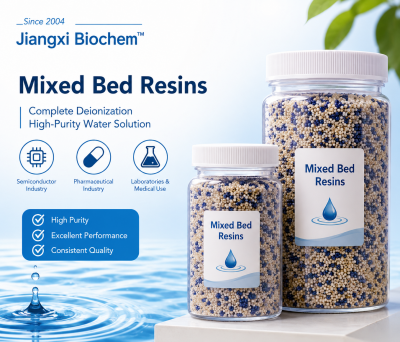
| Pre-blended mixed bed | Grade, blend ratio, ionic forms, package condition and the manufacturer’s freeze/thaw guidance for that blend. | Mixed Bed Resins |
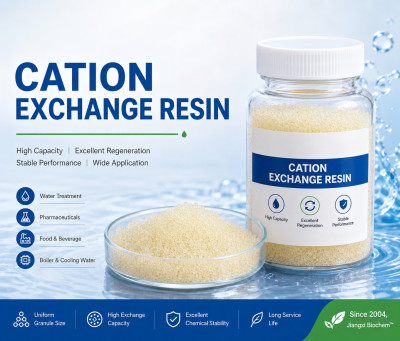
| Cation exchange resin | Strong- or weak-acid type, H⁺ or Na⁺ form, bead condition and current TDS limits. | Cation Exchange Resin |
| Anion exchange resin | Strong- or weak-base type, OH⁻ or Cl⁻ form, moisture protection and air exposure. | Anion Exchange Resins |
Temperature figures below describe the named supplier’s products and guidance. They are examples for comparison, not a universal specification for all mixed bed, cation or anion resins.
| First-party guide | Documented point | How buyers should use it |
|---|---|---|
| DuPont: Proper Storage Conditions (Rev. 4, Oct. 2024) | For DuPont resins, the guide recommends 2–40°C indoor storage for best results; below 0°C can cause freezing, and repeated freeze/thaw cycles can damage beads. | Apply only when the resin and conditions fall within the document’s scope; check the product data sheet for exceptions. |
| DuPont: Freeze/Thaw Guidance | It expects no damage from one freeze/thaw cycle for new resin in unopened original packaging, while used resin stored in water and resin in liquid-filled vessels are identified as potential-damage cases. It calls for ambient thawing and no heat source. | Do not generalize the sealed-package statement to opened stock, repeated cycles or another supplier’s grade. |
| Purolite: Packaging, Storage and Transportation | Purolite recommends storage above 0°C; it says repeated freezing and thawing may damage resin or packaging, and frozen resin should thaw naturally, not mechanically. It also notes that exposed OH-form anion resin can carbonate in air. | Use the guidance for the named product family and protect opened resin from air and package damage. |
| LANXESS: Lewatit Storage Guidelines (2024) | For Lewatit resins, it recommends storage above water’s freezing point; if frozen, allow gradual ambient thawing and wait until fully thawed before handling. | The guide states that the specific product data sheet prevails where instructions differ. |
Jiangxi Biochem Co., Ltd. is listed on its product pages as a China-based supplier of ion-exchange resins. For a sourcing inquiry, specify the application, system configuration, required ionic form, target water-quality criteria, quantity, destination and planned delivery window. Visit the official contact page to request grade-specific information.
In Mixed Bed Resin, cation-exchange beads release hydrogen ions as they capture dissolved cations, while anion-exchange beads release hydroxide ions as they capture anions. Hydrogen and hydroxide combine to form water. The exact blend and operating conditions are grade-specific.
Cation Exchange Resin exchanges positively charged ions; Anion Exchange Resin exchanges negatively charged ions. H⁺, Na⁺, OH⁻ and Cl⁻ forms serve different process roles, so selection follows feed-water chemistry, target quality and the system design.
Where a Mixed Bed Resin system is designed for on-site regeneration, its cation and anion fractions are commonly separated before they receive their respective regenerants, then remixed after conditioning. Separation efficiency, regenerant choice and sequence depend on the resin grade and plant design; follow the equipment and supplier procedure.
No. A pre-blended Mixed Bed Resin still needs installation, rinsing or conditioning and water-quality verification as specified by its TDS and the system manual. Do not release treated water until the plant’s approved criteria are met.
Mixed Bed Resin should be assessed by exact grade, package condition, prior use and freeze/thaw history. DuPont’s single-cycle statement applies to new resin in unopened original packaging; it is not a blanket guarantee for opened or used resin.
Keep Anion Exchange Resin protected from contamination and prolonged air exposure, then reseal opened inventory in a clean suitable container. Purolite notes that hydroxide-form anion resin can carbonate when exposed to carbon dioxide in air; use the relevant grade’s storage instructions.
For a Cation Exchange Resin or Anion Exchange Resin bed, follow the grade-specific thawing, conditioning or regeneration instructions and the equipment manual. Inspect as specified and verify treated water against approved site limits before returning the unit to service.
For Mixed Bed Resin, request a grade-specific TDS, lot COA, SDS, blend and ionic-form details, packaging date and storage guidance. Match the documents to the intended process, water-quality targets and delivery conditions.
Editorial note: This article was prepared by Jiangxi Biochem Co., Ltd. for general sourcing and planning information. It is not a resin-specific operating procedure. The current product TDS, SDS, supplier instructions, system OEM manual and site procedures take precedence.
Topics: #IonExchangeResin #MixedBedResin #CationExchangeResin #AnionExchangeResin #WaterTreatment #ResinStorage #WinterOperations
Latest Blogs & News
Products
Contact us
Add: 1-6F, No.118 Xinzhou Road, Xihu District, Nanchang, Jiangxi, China Post: 330025
Tel:+86-791-86629460
E-mail: iceleng@biochemjx.com