----News
Industrial Grade Cation Exchange Resin Procurement Guide: SAC vs. WAC & TCO Analysis
Date: 2026-08-05
1. Executive Summary & Strategic Procurement Context
Cation exchange resins play a mission-critical role in industrial water treatment, boiler feedwater softening, demineralization, and chemical purification processes. For procurement officers and plant operations managers, choosing between Strong Acid Cation (SAC) and Weak Acid Cation (WAC) resins is not merely a technical decision, but a high-impact financial choice governing chemical consumption, waste neutralization, and long-term Total Cost of Ownership (TCO).
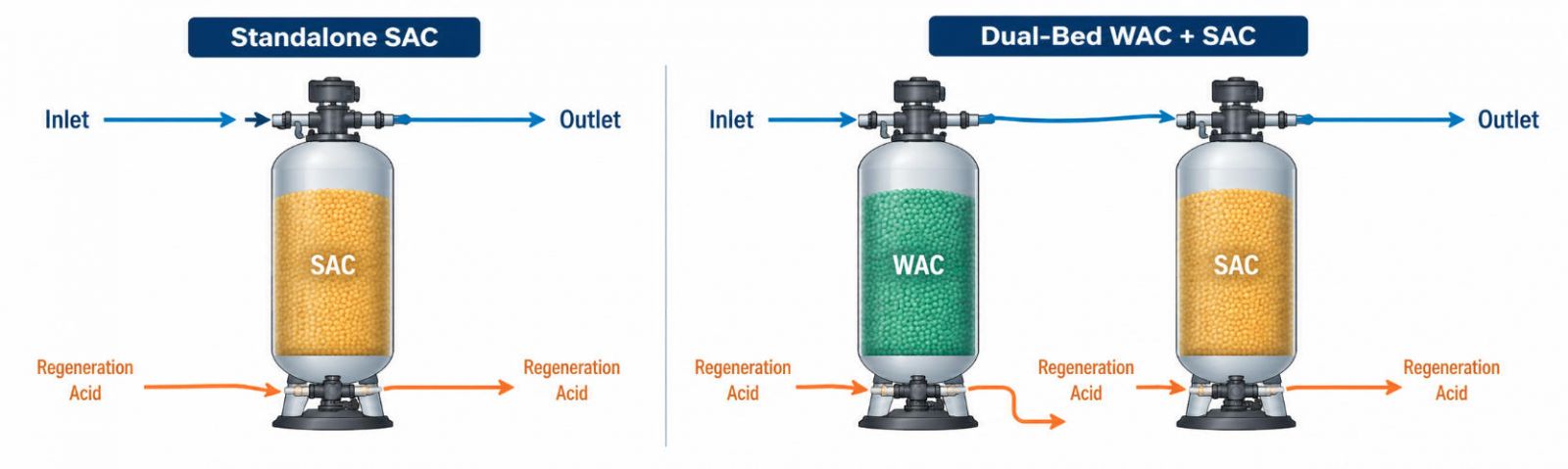
While SAC resins offer full-spectrum cation removal across all pH ranges, WAC resins provide unmatched operating capacity and near-stoichiometric regeneration efficiency for temporary hardness (cations bound to bicarbonate/alkalinity). Integrating WAC as a primary step before SAC (Layered or Dual-Bed configuration) frequently reduces total chemical consumption by 30% to 45%.
2. Fundamentals: SAC vs. WAC Resin Architecture
| Parameter |
Strong Acid Cation (SAC) |
Weak Acid Cation (WAC) |
| Functional Group |
Sulfonic acid (-SO3H) |
Carboxylic acid (-COOH) |
| Matrix Structure |
Styrene-DVB (Gel or Macroporous) |
Acrylic-DVB or Methacrylic-DVB (Macroporous) |
| Operating pH Range |
0 – 14 (Fully ionized at all pH levels) |
5 – 14 (Requires alkalinity / pH > 4.5) |
| Target Cations |
All Cations (Ca2+, Mg2+, Na+, K+, Fe2+) |
Divalent Cations associated with alkalinity (Ca2+, Mg2+) |
| Operating Capacity |
1.8 – 2.2 eq/L (Moderate) |
3.5 – 4.5 eq/L (Extremely High) |
| Regeneration Efficiency |
110% – 150% stoichiometric excess acid (HCl or H2SO4) |
105% – 110% near-stoichiometric efficiency |
| Swelling / Volume Change |
Minimal (< 8% Na+ to H+ form) |
Significant (up to 50% – 80% expansion during regeneration) |
3. Regeneration Dynamics & Stoichiometry
The operating economy of cation exchange processes depends directly on the chemical reaction efficiency during the exhaust and regeneration cycles.
3.1 Strong Acid Cation (SAC) Reaction
Exhaustion: R-SO3H + Na+ ⇌ R-SO3Na + H+
Regeneration: R-SO3Na + HCl (120-150%) → R-SO3H + NaCl
Because the sulfonic group retains strong affinity for divalent cations and moderate affinity for sodium, reversing the exchange reaction requires a substantial excess concentration of free hydrogen ions. This excess acid passes into the waste stream and requires alkaline neutralization before discharge.
3.2 Weak Acid Cation (WAC) Reaction
Exhaustion: 2(R-COOH) + Ca(HCO3)2 ⇌ (R-COO)2Ca + 2H2O + 2CO2
Regeneration: (R-COO)2Ca + 2HCl (105-110%) → 2(R-COOH) + CaCl2
The carboxylic functional group has an extremely high affinity for hydrogen ions. Consequently, nearly all injected acid is consumed during regeneration, producing minimal excess acid in effluent streams and drastically reducing caustic soda (NaOH) spent on neutralization.
4. Total Cost of Ownership (TCO) Financial Model
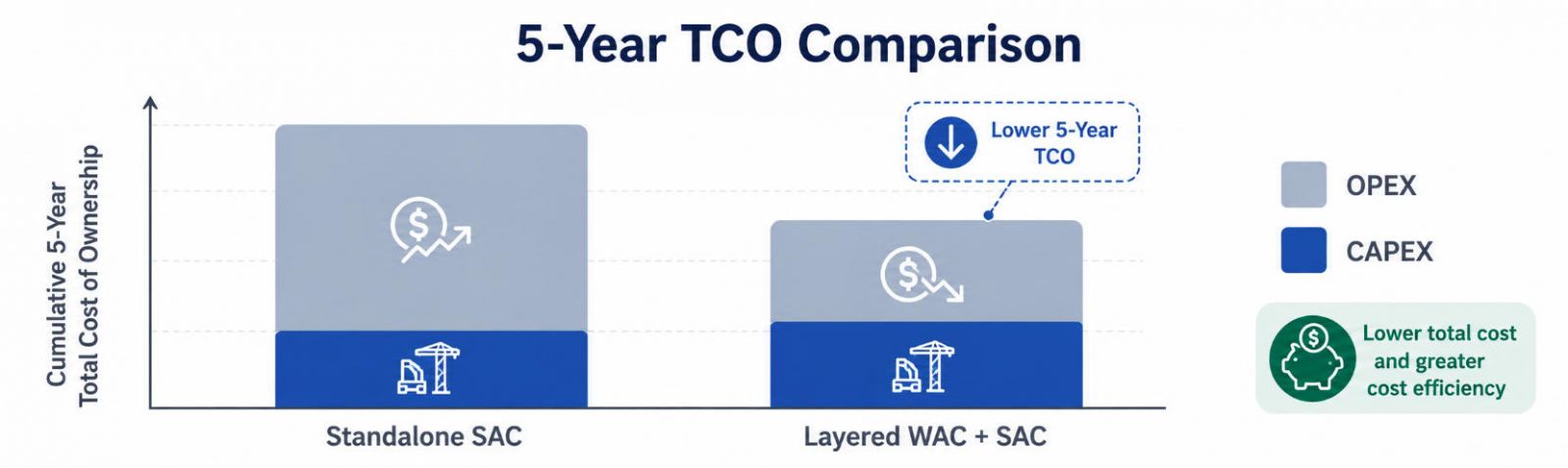
When evaluating resin procurement, focusing solely on the initial resin purchase price (CAPEX) leads to sub-optimal procurement decisions. Operational expenditures (OPEX)—specifically acid consumption, waste neutralization, and rinse water consumption—account for over 75% of the total 10-year lifecycle cost.
TCO = CAPEXResin + Vessel + ∑ ( OPEXAcid + OPEXNeutralization + OPEXRinse + OPEXReplacement )
4.1 Comparative TCO Scenario (100 m³/h Demineralization Plant)
Note on Benchmark Pricing & Sources: Chemical pricing baselines are derived from Q1 2026 industrial chemical market benchmark indices (Industrial Hydrochloric Acid 31% @ ~$120/MT; Liquid Caustic Soda NaOH 30% @ ~$280/MT; Premium Grade Gel SAC Resin @ ~$1,800/m³; Macroporous WAC Resin @ ~$3,100/m³ - Sources: ICIS Chemical Market Report / China Chemical Market Index, Q1 2026).
| Cost Element |
Standalone SAC System |
Layered WAC + SAC System |
Financial Impact / Savings |
Initial Resin Investment (CAPEX)
(Q1 2026 Base Price Reference) |
$45,000 |
$62,000 |
+$17,000 (+37.7% Initial Cost) |
Annual Acid Cost (HCl 31%)
(Ref: ~$120/MT, Q1 2026 Benchmark) |
$88,000 / year |
$49,000 / year |
-$39,000 / year (-44.3%) |
Annual Neutralization (NaOH 30%)
(Ref: ~$280/MT, Q1 2026 Benchmark) |
$34,000 / year |
$12,000 / year |
-$22,000 / year (-64.7%) |
Rinse Water & Wastewater Fee
(Ref: Industrial Water Rate Index 2026) |
$18,000 / year |
$11,000 / year |
-$7,000 / year (-38.8%) |
| Total 5-Year OPEX |
$700,000 |
$360,000 |
-$340,000 Savings |
| Net 5-Year TCO |
$745,000 |
$422,000 |
Net Savings: $323,000 (43.3% TCO Reduction) |
Key Procurement Insight: Payback Period
The initial premium paid for WAC resin and vessel modification is typically recovered within
4 to 7 months of continuous operation due to chemical savings in acid and neutralization caustic.
5. Procurement Decision Framework
To determine the optimal resin selection for your facility, assess raw water chemistry according to the following criteria:
- High Alkalinity Water (Hardness/Alkalinity Ratio ≤ 1.0): Deploy a WAC + SAC combined bed. WAC removes temporary hardness at 100% capacity, leaving only permanent hardness and neutral salts for SAC.
- Low Hardness / High Sodium Water: Deploy Standalone SAC. WAC resin will not exchange sodium efficiently and will remain inactive.
- High Oxidant / High Organic Waters: Select Macroporous SAC/WAC resins to resist osmotic shock and physical fouling from free chlorine or organics.
- Vessel Design Constraints: When adding WAC resin, ensure column design accounts for 50%–80% resin bed expansion during exhaust/regeneration cycles to prevent vessel over-pressurization.
6. Frequently Asked Questions (FAQ)
Q1: Can WAC resin completely replace SAC resin in total demineralization systems?
No. WAC resin cannot split neutral salts (such as NaCl or Na2SO4) and only exchanges cations bound to weak acid anions (alkalinity). A SAC resin downstream is still mandatory for total cation removal in demineralization processes.
Q2: Why does WAC resin expand by up to 80% during operation?
WAC resin undergoes significant structural volume change when converting from the exhausted ionic state (e.g., Ca/Mg form) to the regenerated hydrogen (H+) form due to carboxyl group hydration and osmotic stress. Column vessels must incorporate adequate freeboard space to accommodate this swelling.
Q3: What is the typical service life of SAC vs. WAC resins in industrial water treatment?
Under normal operating conditions with chlorine levels < 0.1 ppm, high-quality Gel SAC resins last 5 to 8 years, while Macroporous WAC resins typically serve 6 to 10 years owing to their durable acrylic or methacrylic cross-linked matrix.
7. Procurement Technical Evaluation Checklist
- ☑ Total Exchange Capacity: Verify standard lab reports (≥ 2.0 eq/L for SAC, ≥ 4.2 eq/L for WAC).
- ☑ Particle Size Uniformity: Request Uniformity Coefficient (UC) ≤ 1.2 to minimize pressure drop and operational channelling.
- ☑ Cross-Linking Degree: Require 8% to 10% DVB cross-linking for SAC in high-temperature or oxidative environments.
- ☑ Chemical Resistance: Confirm thermal stability up to 120°C for SAC (H+ form) and 100°C for WAC.
- ☑ Supplier Quality & Batch Consistency: Inspect Certificate of Analysis (CoA) for osmotic stability (> 95% whole uncracked beads).
Return