Chemical & Physical Properties
- Appearance: Colorless gas or liquefied gas
- Boiling Point: 12.5°C (54.5°F)
- Melting Point: -107.3°C (-161.1°F)
- Density: 1.35 g/cm³ (liquid)
- Vapor Pressure: 1380 mmHg at 20°C
- Solubility: Reacts violently with water, forming hydrogen chloride and boric acid
- Corrosiveness: Highly corrosive to metals, glass, and human tissue
Key Features & Benefits
✅ Powerful Lewis Acid: Effective in electrophilic substitution and catalysis
✅ High Reactivity in Chemical Synthesis: Ideal for halogenation and boron compound production
✅ Critical in Semiconductor Processing: Used in plasma etching and high-purity material fabrication
✅ Strong Catalyst for Polymer & Petrochemical Industries: Enhances reaction efficiency in industrial applications
✅ Ultra-Pure Grades Available: Suitable for electronics and pharmaceutical applications
Industrial Applications
Semiconductor & Electronics Industry
- Plasma Etching & Chemical Vapor Deposition (CVD):
- Used for selective etching of materials such as tungsten, silicon oxides, and nitrides.
- Employed in advanced microelectronics fabrication.
- Doping Agent in Semiconductor Processing:
- Used to introduce boron into silicon wafers, modifying their electrical properties.
Organic & Inorganic Synthesis
- Catalyst in Organic Reactions:
- Used in Friedel-Crafts alkylation and acylation reactions.
- Plays a role in synthesizing boron-containing fine chemicals and pharmaceuticals.
- Halogenation Agent:
- Used in the synthesis of boron halides and other specialty chemicals.
Petrochemical & Polymer Industry
- Catalyst in Hydrocarbon Processing:
- Enhances polymerization reactions in the production of specialty plastics and elastomers.
- Lubricant & Coating Additives:
- Forms high-performance lubricants with superior thermal stability.
High-Performance Materials & Aerospace
- Boron Fiber & Boron Nitride Production:
- Used as a precursor in manufacturing advanced composite materials with high strength-to-weight ratios.
Reactivity & Safety Considerations
⚠️ Highly Corrosive & Toxic Gas!
- Water Sensitivity: Reacts violently with water, releasing hydrogen chloride (HCl), a toxic and corrosive gas.
- Air Sensitivity: Must be handled in a dry, controlled environment to prevent hazardous reactions.
- Handling Precautions:
- Use only in fume hoods or enclosed systems with proper ventilation.
- Avoid exposure to moisture, skin, and eyes.
Handling & Storage
- Storage Conditions:
- Store in tightly sealed, moisture-free cylinders under dry, inert gas (argon or nitrogen).
- Keep in a well-ventilated, temperature-controlled storage area.
- Personal Protective Equipment (PPE):
- Chemical-resistant gloves, safety goggles, and protective clothing.
- Use gas detection systems and emergency response protocols.
- First Aid Measures:
- Inhalation: Move to fresh air immediately; seek medical attention.
- Skin/Eye Contact: Flush with large amounts of water and seek emergency care.
Packaging & Availability
Available in:
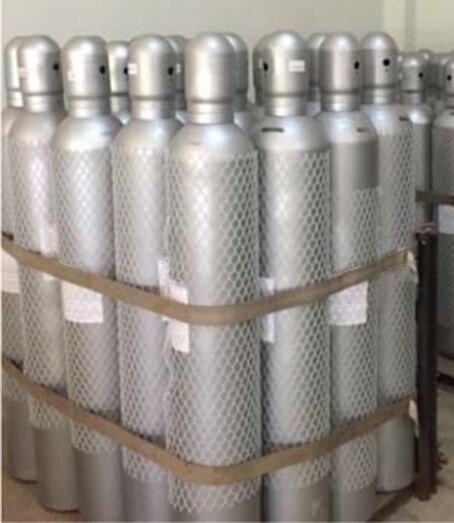
- 50L, 100L cylinders
- Custom purity levels and complex solutions available upon request (electronic-grade, high-purity industrial-grade)
붕소 삼염화물(BCl₃)은 무색, 유독성, 고반응성을 지닌 자극성 냄새가 나는 가스이다. 강력한 루이스 산으로서 유기 합성, 반도체 제조 및 고성능 소재 생산에서 중요한 역할을 한다. 수분이 존재할 때 쉽게 가수분해되어 염화수소(HCl)와 붕산 유도체를 형성한다. BCl₃은 에칭 공정, 촉매 생산 및 화학 기상 증착(CVD) 반응제로 널리 사용된다.